

New light on the huge storm on the Sun that affected the Earth 2688 years ago
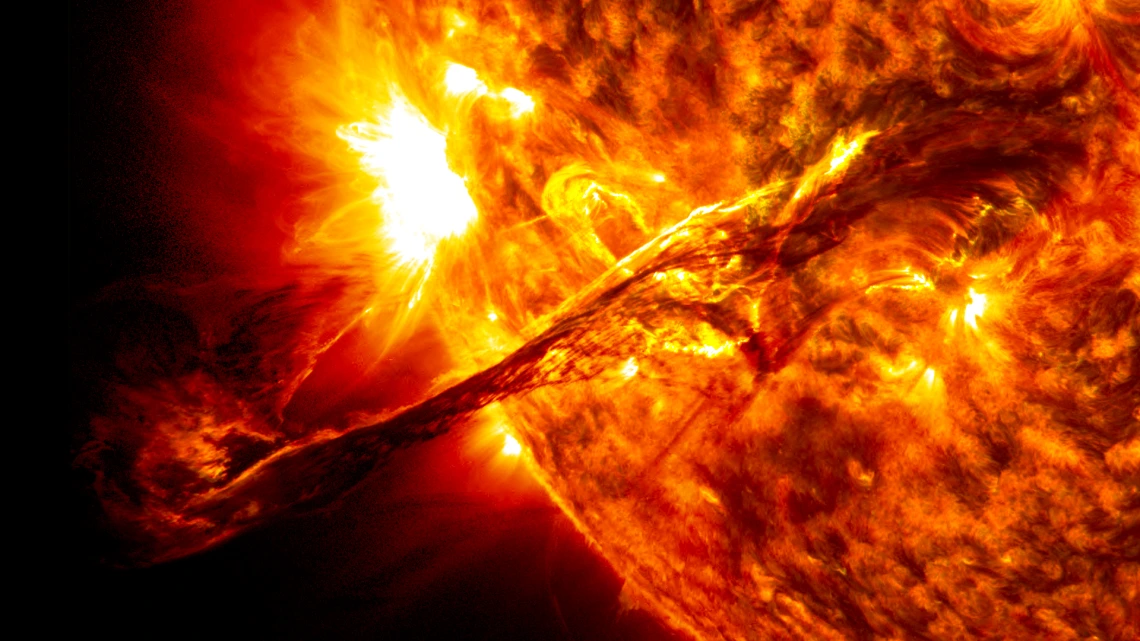
Huge eruptions on the Sun occasionally hit the Earth, with effects that would be devastating for our technological civilization. While lesser solar storms have been witnessed in modern times, the most extreme have been deduced from the sudden increases in the amount of carbon-14 (14C) appearing in tree rings and beryllium-10 (10Be) in ice cores. These are known as Miyake Events, and are relatively rare, with centuries passing between events. A team of authors led by Irina Panyuskina of the LTRR has published an article in the journal Communications Earth & Environment which uses new tree-ring and 14C data to elucidate more details of the Miyake event around 660 BCE, refining the dating to between 664 and 663 BCE, and considering the processes between the solar storm causing increased 14C production in the atmosphere and the trees incorporating it in their rings.
University of Arizona News story
When trees 'talk:' Researchers probe ancient wood for clues about massive solar storms (by Penny Duran and Daniel Stolte)
Original article
Panyushkina, I.P., Jull, A.J.T., Molnár, M. et al. The timing of the ca-660 BCE Miyake solar-proton event constrained to between 664 and 663 BCE. Commun Earth Environ 5, 454 (2024). https://doi.org/10.1038/s43247-024-01618-x
Popular article with details of the archaeological sources of some tree-ring samples
Solar superstorm in 664 BCE recorded in tree rings (by Shireen Gonzaga)