

What is Dendrochronology?
Dendrochronology is the dating and study of annual rings in trees. The word comes dendros ('involving trees'), chronos ('time'), and ology ('the study of'). More specifically, dendrochronology is the study of events and processes though time made possible by analysis for the annual growth rings of trees. A dendrochronologist is therefore a scientist who uses tree rings to answer questions about the natural world and humans activity through time.
What do tree rings tell us?
The practical applications of the study of tree rings are numerous, involving the earth and environmental sciences, ecology, and anthropology amongst other. Dendrochronology is a truly interdisciplinary science: and its theory and techniques can be applied to many applications. Dendrochronologist study everything from the smallest of cells to the Earth's entire ecosystem. See our subdisciplines for some examples of the many ways we apply the information in the rings of trees to study human and natural systems. Our diverse research interests have in common the following objectives:
- to put the present into a long-term historical context
- to better understand current environmental processes and conditions
- to improve understanding of possible future environmental issues
Why Not Just Count the Rings?
Ring-counting does not ensure the accurate dating of each individual ring. Numerous studies illustrate how ring-counting leads to incorrect conclusions drawn from inaccurate dating. Dendrochronologists demand the assignment of a single calendar year to a single ring. Various techniques are used to crossdate wood samples to assure accurate dating.
Crossdating is dendrochronology's most fundamental technique. It requires matching ring-growth characteristics across many samples from a single area. This allows the dendrochronologist to identify 'locally absent' rings in individual trees and individual years allows identification of the exact year of formation for each ring. A graphical method called 'skeleton plotting' is one method of crossdating, but increasingly dendrochronologist also use cutting-edge computational tools and high-resolution imagery to supplement and extend these tradition techniques.
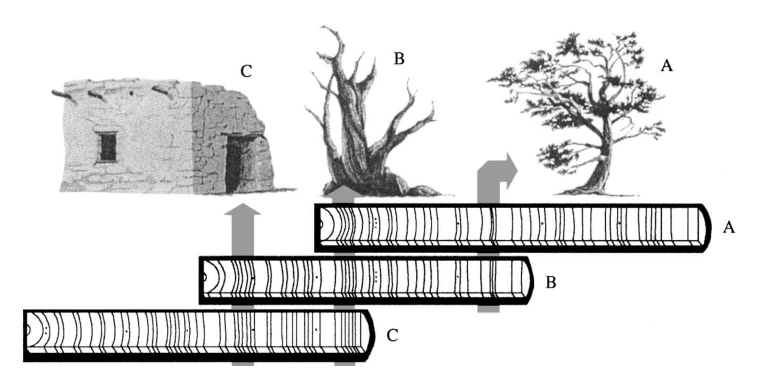
Crossdating also allows us to use dead trees and wood incorporated into human structures. Thus our science is not limited to lifespan of living trees, but rather we can piece together the past by matching distinct patterns of wide and narrow rings from liviing trees, to dead wood, to architectural timbers. These careful methods allow us to build continuous chronologies at year-by-year resolution over 12,000 years into the past.
And its not just the width of the rings
Crossdating allows us to establish the exact year a ring formed, providing precision chronological information. And the width of each ring can tell us something about the climate or environment the tree experienced in the year that ring was formed. But we can also use other physical and chemical measurements to extract even more information from each exactly dated ring. We can tell whether a tree used water from snow or from summer storms, whether there was a forest fire, if humans modified the tree for their own uses, whether there was a sudden cold snap or a heat wave, and even how strong or weak the Sun was. Each ring therefore potentially contains a treasure trove of information about the past that can help us understand how human and natural systems function and what this indicates about the present and future.